Justice is More Than Fairness

Justice is More Than Fairness
By Reggie Shuford
Two months ago, Independence Foundation announced our new strategic plan, a guide that will direct our work in the philanthropic sector in the years ahead (a plan we are gradually implementing between now and the summer of 2028). Embedded in the plan is what we call the “justice framework.”
Justice is a term that can be vague and subjective, depending upon the speaker or the listener. I say this as someone who has spent most of my career as a civil rights attorney, in spaces where justice was often lacking but that we strived toward, demanding that the principle of “equal protection under the law” be more than words on paper.
So, what is justice? In our strategic plan, we are clear that justice encompasses fairness (which itself is a subjective term), but the two are not the same. Justice is a comprehensive set of circumstances in which people have what they need to survive and thrive, can claim their rights, and participate fully in civil and cultural life.
That’s a lot. It’s a big picture. So, in our plan, we’ve identified four interconnected focus areas within that framework of justice:
- Equitable policies and systems;
- Access to rights and legal protections;
- Decarceration and restorative pathways; and
- Narrative power and influence.
These focus areas do not function in siloes. Equitable policies and systems create the conditions for rights to be realized. Too often, public policy, the political culture, and the systems we are required to interact with create inequality. We want to see that change.
Access to rights and legal protection ensures individuals can navigate, benefit from, and be protected by those systems. We don’t want rights to exist merely as an unfulfilled idea. They have to be actualized and practiced.
Decarceration and restorative pathways address harm caused when systems fail. People who are ensnared in the criminal legal system pay for their actions over and over again, beyond sentences issued by courts, through barriers to work, housing, and education. Restorative pathways create opportunities for diversion, repair, reintegration, and community stability.
Narrative power and influence shape public understanding, build civic will, and shift the stories that determine which policies are possible and whose rights are prioritized. People who are most impacted by the three other focus areas we’ve identified must be heard. But they often are not. They have the lived experience of navigating inequitable systems.
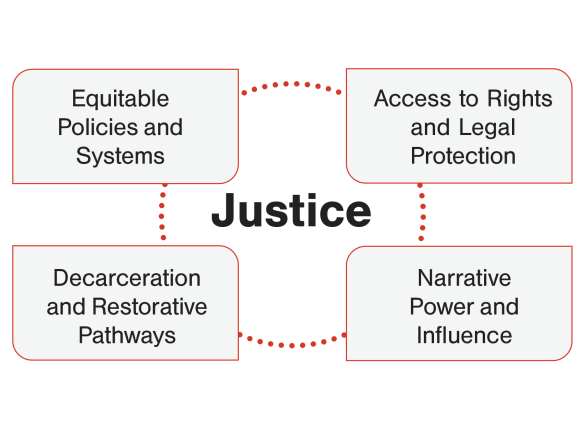
This is the structure that builds our justice framework. By supporting work being done in these areas, Independence Foundation seeks to advance what we believe justice to be. This is how we cultivate equity, well-being, and vibrancy in the greater Philadelphia region. That’s what we want our colleagues in philanthropy and the broader nonprofit world to understand.
Creating a society based on this justice framework is long-term, generational work. Our country’s history is littered with injustice and inequality. But it’s also highlighted by people working for a better world. That’s what inspires us. And we know that there are people in the greater Philadelphia region doing that work today. In our corner of the philanthropic world, we want to be part of supporting them. That’s what our strategic vision is all about.

